| Atropine (U.S.N.L.M.) | |
|---|---|
| (Myopia prevention) | 1 drop 0.05%1, 9 to 1% qhs (0.5% to 1% starting dose has proved effective for high rates of progression.2 (1% starting dose used monthly in alternating eyes has shown good results in one study.7) |
| Chem Specs | atropine sulfate, common prepared concentrations: 0.01%, 0.025%, 0.050%, 0.1% (standard commercial availability 1%) |
| Quantities | Standard commercial quantities: 2,5,15ml |
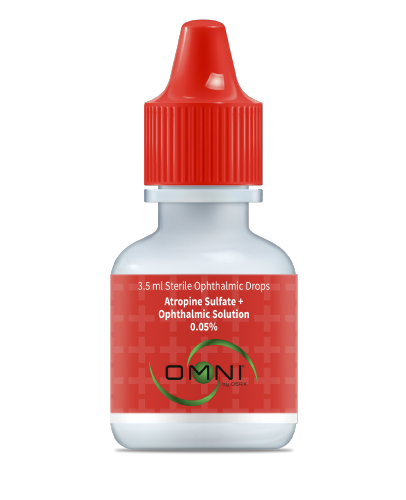
| Cost | $45.00 3.5ml compounded 0.05% at OSRX® |
| Class | anticholinergic |
| Action | Competitive antagonist for the muscarinic acetylcholine receptor. |
| Usage | Indicated for cycloplegia, mydriasis, amblyopia penalization. Used off label to prevent myopic progression. |
| (Myopia prevention) | Atropine therapy is dose dependent so the magnitude and rate of change of myopia should determine the dosage. The 0.01% concentration is no better than placebo in one study,11. Rebound after cessation can be avoided with a taper regardless of dosage used4. Mydriasis (but not cycloplegia10) is present with low dosages (to 0.05%) and may be addressed with photochromic lenses. |
| Warnings | Increased susceptibility in infants, young children, and in children with blond hair, blue eyes, Down's syndrome, spastic paralysis, or brain damage. Ointment form thought to reduce systemic absorption. Elevated blood pressure reported following conjunctival instillation of 1% solution. |
| Contraindications | Hypersensitivity to the product. |
| Adverse Reactions | Pain on instillation, superficial keratitis, dry eye, skin, mouth, and throat. Restlessness, irritability, delirium, tachycardia. |
| Pediatric use | Avoid under 3 months of age. Limit 1% solution to once daily under age 3. |
| Pregnancy | Category C. No adequate studies in pregnant women. |
2. Polling JR, Tan E, Driessen S, et al. Eye (Lond). 2020 Sep 21.
3. JAMA Ophthalmol; 2021 Jan 14; EPub Ahead of Print; J Wang, Y Li, DC Musch, et. al.
4. Zhu et. al., Efficacy and Safety of 1% Atropine... Int J Med Sci. 2020; 17(2): 176–181.
5. Joachimsen L, Böhringer D, Gross NJ, et al. Ophthalmol Ther. 2019 Jun 12.
6. Risacher, McDonald, Tallman, et al. JAMA April 18, 2016.
7. Zhu Q, Tang Y, Guo L, et al. Int J Med Sci. 2020 Jan;17:176-181.
8. Cooper et. al., Optometry and Vision Science: December 2013 - Volume 90 - Issue 12 - p 1467-1472.
9. Jason C. Yam, et.al.,https://jamanetwork.com/journals/jama/article-abstract/2801319, February, 2023
10. Breliant, et al., Optom Vis Sci. 2023 Jun 6. doi: 10.1097/OPX.02031. Online ahead of print.
11. Repka, Weise, Chandler; et al JAMA Ophthalmol. Published online July 13, 2023. doi:10.1001/jamaophthalmol.2023.2855
12. Zadnick et. al.,JAMA Ophthalmol. 2023 Oct; 141(10): 990–999. Published online 2023 Jun 1. doi: 10.1001/jamaophthalmol.2023.2097